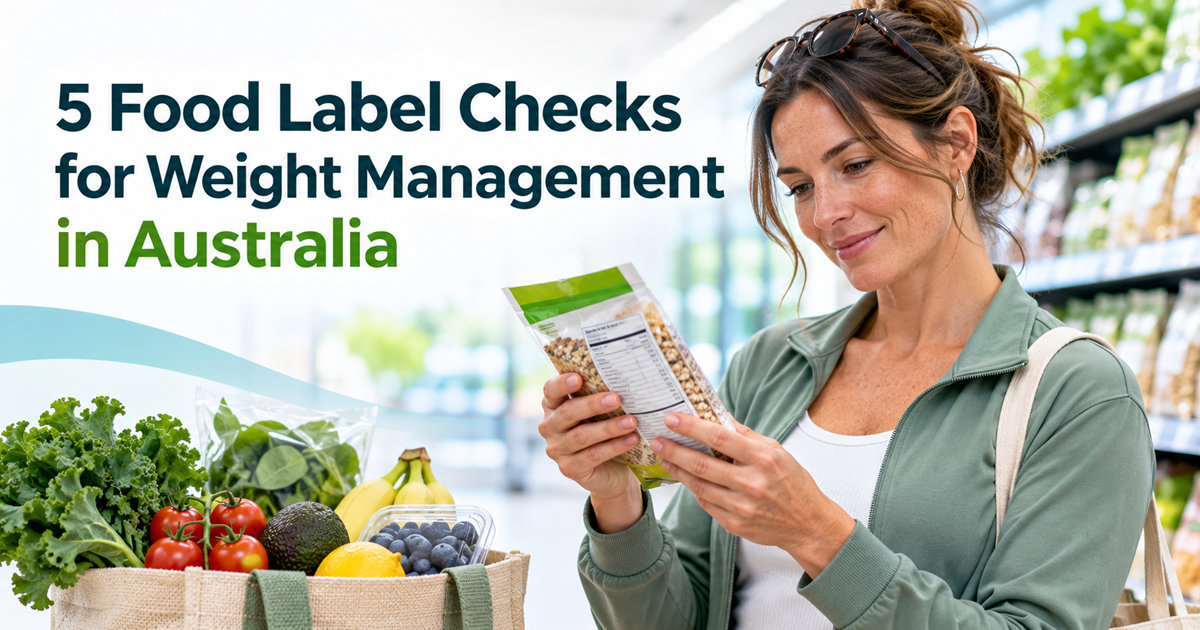
You're standing in the supermarket comparing two breakfast cereals. One says "high protein", while the other has a higher Health Star Rating. Both look like reasonable choices, but which one actually suits your needs?
Food packaging can be confusing, especially when you're trying to make healthier eating choices.
The good news is that you don't need to be a nutrition expert to understand the basics.
When reading food labels in Australia, focus on five things: the nutrition information per 100 g, serving size, energy content, sugars and ingredients, and the overall nutritional value of the food.
These details can help you compare similar products and choose foods that fit your eating habits and health goals.
Here's how to make sense of food labels without getting caught up in marketing claims.
Why Is Reading Food Labels Useful for Weight Management?
Food labels provide information about what's in packaged food, including its energy content and important nutrients.
When you're managing your weight, understanding this information can help you make more informed choices.
For example, two breakfast cereals may look similar but contain different amounts of sugar, fibre or energy.
The same applies to yoghurt, bread, snacks and other everyday supermarket products.
Reading the nutrition panel allows you to compare these differences rather than relying only on the claims printed on the front of the packet.
However, food labels are just one part of healthy eating. Your overall food choices, individual nutritional needs and eating patterns matter too.
1. Compare the Nutrition Information Per 100 g
One of the easiest ways to compare packaged foods is to check the per 100 g column on the nutrition information panel.
For drinks, this is usually shown per 100 mL.
Australian nutrition panels generally display two columns:
- Quantity per serving
- Quantity per 100 g or 100 mL
The per 100 g column is useful because different brands may use different serving sizes.
For example, one cereal manufacturer might suggest a 30 g serving while another suggests 45 g.
Comparing only the per-serving numbers could make the products difficult to evaluate fairly.
Instead, compare their nutrition information per 100 g.
Look at factors such as energy, sugars, saturated fat, sodium and fibre where listed.
Practical tip: Compare similar foods, such as one breakfast cereal with another, rather than comparing unrelated products.
2. Check the Serving Size and Number of Servings
Serving size is another important detail.
The serving size printed on food packaging is set by the manufacturer. It doesn't necessarily represent how much you personally eat.
For example, a packet of crackers may list its nutrition information for a serving of four crackers.
But what if you normally eat eight?
You would be consuming approximately twice the energy and nutrients listed for one serving.
The same principle applies to cereals, snacks, sauces and drinks.
A Simple Example
Imagine a packaged food lists:
Serving size: 40 g
Energy per serving: 700 kJ
If you eat 80 g, the energy would be approximately 1,400 kJ.
These are hypothetical figures to explain how serving sizes work.
This doesn't mean you need to weigh every meal or count every kilojoule.
It simply helps to understand how the listed serving size compares with the amount you usually eat.
3. Look at the Energy Content
Energy on Australian food labels is usually measured in kilojoules (kJ). Some products also display calories (kcal).
Your body needs energy for everyday activities, movement and normal bodily functions.
When managing body weight, overall energy intake is one factor that may be considered alongside physical activity, health and other individual needs.
However, the energy number alone doesn't tell you whether a food is nutritious.
For example, nuts contain substantial energy but also provide nutrients such as unsaturated fats, protein and fibre.
A food with fewer kilojoules isn't automatically the better choice for every person or meal.
When comparing foods, consider what the product contributes to your overall diet.
If you're unsure about your energy needs, a qualified healthcare professional or dietitian can help you understand what is appropriate for your circumstances.
4. Check Sugars and Read the Ingredient List
The sugar content of packaged foods can be confusing.
You might see products labelled:
- No added sugar
- Reduced sugar
- Low fat
- Naturally sweetened
These descriptions can be useful, but they don't provide the complete nutritional picture.
Does 'No Added Sugar' Mean Sugar-Free?
No.
The sugars figure on an Australian nutrition information panel includes both naturally occurring and added sugars.
For example, plain milk contains naturally occurring lactose, while fruit contains naturally occurring sugars.
A product labelled "no added sugar" may still contain naturally occurring sugars.
To understand more about a product, look at both its nutrition panel and ingredient list.
Why Does the Ingredient List Matter?
Australian packaged foods generally list ingredients in descending order by weight.
This means the ingredient listed first contributed the greatest amount by weight when the food was made.
If sugar or a sugar-containing ingredient appears near the beginning of the list, it may be a significant component of the product.
However, the ingredient list alone doesn't tell you the precise amount of every ingredient.
Practical tip: When comparing similar products, use the sugars figure alongside the ingredient list and the food's overall nutritional value.
You can learn more from Food Standards Australia New Zealand.
5. Consider Fibre, Protein and the Health Star Rating
Healthy eating involves more than looking at kilojoules or sugar alone.
Protein, dietary fibre and the overall composition of the food are also worth considering.
Look for Fibre
Fibre is found in foods such as wholegrains, vegetables, fruit and legumes.
It supports digestive health and is an important part of a balanced diet.
When comparing similar products, such as wholegrain breads or breakfast cereals, fibre content can be one useful consideration.
Remember that fibre isn't always displayed on every nutrition panel unless required by a relevant nutrition claim or other labelling rule.
Consider Protein
Protein supports normal body functions, including the maintenance and repair of body tissues.
Everyday sources include eggs, fish, lean meat, dairy foods, tofu, beans and lentils.
When comparing similar packaged foods, protein content may be useful to consider alongside other nutrients.
However, a product described as "high protein" isn't automatically suitable for everyone's nutritional needs.
Understand the Health Star Rating
Australia's Health Star Rating system appears on some packaged foods.
Products can receive a rating from half a star to five stars.
The system helps shoppers compare the nutritional profile of similar packaged products.
For example, you can compare two breakfast cereals using their Health Star Ratings.
But comparing a breakfast cereal with a yoghurt using star ratings is not appropriate because they belong to different food categories.
Also, the Health Star Rating system is voluntary, so not every packaged food displays one.
A higher rating can help guide a choice between similar products, but it doesn't tell you how much of a food you should eat.
Quick Food Label Checklist for Your Next Grocery Shop
Here's a simple checklist to use when comparing packaged foods.
| What to check | Why it matters |
|---|---|
| Per 100 g or 100 mL | Helps compare similar foods fairly |
| Serving size | Helps relate the label to the amount you eat |
| Energy (kJ) | Shows how much energy the food provides |
| Sugars and ingredients | Helps understand the food's composition |
| Fibre, protein and Health Star Rating | Provides additional information about nutritional value |
You don't need to spend several minutes studying every product.
Start by comparing a few foods you regularly buy, such as bread, cereal or yoghurt.
Over time, reading the labels may become easier.
Are Foods with Health Claims Always Better Choices?
Not necessarily.
Words such as "natural", "high protein" or "low fat" can make a product sound appealing.
Some nutrition claims have specific regulatory requirements, but a single claim doesn't describe the whole food.
For example, a product labelled "low fat" may still contain substantial energy or sugar.
It's worth checking the complete nutrition panel before deciding whether the food suits your needs.
Similarly, packaged foods aren't automatically better simply because they display a Health Star Rating.
Fresh vegetables, fruit and many other nutritious foods may have no nutrition panel at all.
The goal is to build a varied eating pattern, rather than choose foods based only on attractive packaging.
For more on making realistic food choices, read our article Navigating the Hype of Trendy Diets: Why Sustainable Weight Loss Matters.
How Does Nutrition Guidance Fit into Weight Management?
Reading food labels can help you understand what you're buying, but nutritional requirements differ from person to person.
Age, health conditions, physical activity, medications and individual circumstances may all influence what is appropriate.
For some people, general healthy eating guidance may be sufficient. Others may benefit from professional nutritional advice or a personalised weight-management plan.
If you're exploring weight loss treatments in Australia, consider whether the service includes appropriate clinical assessment, nutrition guidance and ongoing support.
At Dr Franks Australia, weight-management care begins with an assessment of individual health needs and goals.
The service offers doctor-led telehealth consultations, personalised nutrition and lifestyle guidance, and ongoing clinical reviews.
You can explore Dr Franks' personalised treatment plans to learn more about the available support.
Make More Informed Food Choices with Dr Franks Australia
Reading food labels is a practical skill that can help you make more informed decisions during grocery shopping.
You don't need to follow every new food trend or choose products based on marketing claims.
Start by understanding the nutrition panel, comparing similar foods and considering what fits your individual needs.
Dr Franks Australia offers personalised weight-management support through clinical assessment, nutrition and lifestyle guidance, and ongoing care.
If you'd like to explore professional support, you can begin with the online eligibility assessment.
Explore Your Weight Management Options
Dr Franks Australia
Website: www.drfranksaustralia.com.au
Medical disclaimer: This article provides general nutritional information and is not a substitute for individual medical advice. Dietary needs vary, particularly for people with medical conditions or specific nutritional requirements. Seek advice from an appropriately qualified healthcare professional when needed.
Frequently Asked Questions
What is the easiest way to compare food labels in Australia?
Use the per 100 g or per 100 mL column to compare similar packaged foods. This allows you to compare nutritional values even when manufacturers use different serving sizes.
Is a lower-kilojoule food always better for weight management?
No. Energy content is one consideration, but the food's nutritional value, portion size and place in your overall diet matter too.
Does 'no added sugar' mean a product contains no sugar?
No. Foods can contain naturally occurring sugars even when no sugar has been added during manufacturing.
What does a five-star Health Star Rating mean?
A five-star rating indicates a stronger nutritional profile under the Health Star Rating system. It is intended for comparing similar packaged foods, rather than determining whether a food is suitable for everyone.
Should I look at protein or fibre when buying food?
Both can be relevant. Protein and fibre contribute to a balanced diet, but your needs depend on your health, dietary pattern and circumstances.
Can a healthcare professional help with nutrition during weight management?
Yes. A qualified healthcare professional or dietitian can provide individual guidance based on your health, nutritional needs and goals.